
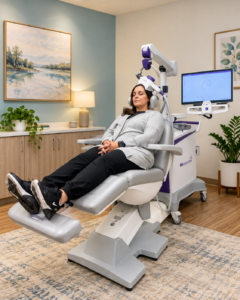
If depression symptoms have continued despite previous treatment, you may be wondering whether Transcranial Magnetic Stimulation (TMS) could be an option.
AMD Medical, PLLC offers NeuroStar Advanced Therapy, a non-invasive treatment that uses magnetic pulses to stimulate areas of the brain involved in mood regulation.
Whether TMS is appropriate depends on your diagnosis, treatment history, current medications, medical history, and other individual factors. A clinical evaluation is required before treatment begins.
NeuroStar TMS may be considered for appropriate patients including:
Individual eligibility may vary. Insurance plans may also have their own medical-necessity and prior-authorization requirements.
Every patient has a different treatment history.
During a TMS consultation, our clinical team will review information such as:
This information helps our providers determine whether NeuroStar TMS may be appropriate for you.
NeuroStar TMS is a non-invasive treatment performed in the office. Magnetic pulses are delivered to targeted areas of the brain involved in mood regulation.
Treatment does not require anesthesia, and patients are generally able to return to their normal daily activities after a treatment session.
The length and frequency of treatment can vary based on the patient’s diagnosis, treatment plan, clinical response, and provider recommendations.
Depression can affect mood, energy, sleep, concentration, motivation, relationships, and daily functioning.
For adults experiencing Major Depressive Disorder who have not achieved satisfactory improvement with prior antidepressant medication treatment, NeuroStar TMS may provide another treatment option to discuss with a psychiatric provider.
A consultation allows our team to review your treatment history and determine whether you meet the clinical criteria for treatment.
Some people with Major Depressive Disorder also experience significant anxiety symptoms.
NeuroStar Advanced Therapy is indicated for the treatment of depressive episodes and for decreasing anxiety symptoms in adults with MDD who experience comorbid anxiety symptoms and who have not achieved satisfactory improvement from previous antidepressant medication treatment.
A clinical evaluation is necessary to determine whether this treatment is appropriate for your individual situation.
NeuroStar Advanced Therapy may also be used as an adjunctive treatment for adults with Obsessive-Compulsive Disorder.
Adjunctive treatment means that TMS may be used as part of a broader treatment plan rather than automatically replacing medications, psychotherapy, or other care recommended by your providers.
Our clinical team will review your current and previous OCD treatment before determining whether NeuroStar TMS may be appropriate.
NeuroStar Advanced Therapy is also indicated as an adjunctive treatment for Major Depressive Disorder in adolescents ages 15 through 21.
Because treatment decisions for adolescents require careful consideration of diagnosis, medical history, previous treatments, medications, and other clinical factors, each patient must be evaluated individually by a provider.
If our provider determines that TMS is appropriate, our team will explain:
When insurance authorization is required, our office can complete a benefits investigation and assist with the prior-authorization process.
If depression symptoms have continued despite previous treatment, or if your physician, therapist, or other healthcare provider has referred you for a TMS evaluation, AMD Medical can help determine the next appropriate step.
NeuroStar Advanced Therapy is available by prescription, and individual results vary.
Call AMD Medical at 254-424-9523 to learn more about scheduling a TMS consultation.